A pro forma invoice is a preliminary document that states the value of goods or services without constituting a request for payment. It is mainly used for informational purposes, for example in customs clearance or as a quotation template. Unlike a regular invoice, it does not trigger any obligation to pay, but it is still an important document for international trade.
What is a pro forma invoice?
A pro forma invoice documents the value of the goods in a shipment without constituting a request for payment. You often use it in international trade to state the value of the goods shipped to customs authorities, especially when they have no commercial value. Even though it has “invoice” in its name, it is not a legally binding request for payment.
Typical use cases for the pro forma invoice
Pro forma invoices are indispensable in situations where the value of the goods needs to be documented but no payment should be triggered. Typical use cases include exports to non-EU countries, shipping samples, or handling prepayment transactions.
Pro forma invoices are used in various scenarios, for example:
- Sample shipments: When you send product samples that have no commercial value.
- Gift shipments: For sending gifts abroad.
- Replacement shipments: When you deliver goods free of charge as a replacement.
- Donations: When sending donations that do not require payment.
- Shipments against prepayment: When a preliminary invoice is needed before a commercial invoice is issued.
Who is the pro forma invoice relevant for?
Self-employed individuals and freelancers
As a self-employed person or freelancer, you are often responsible for creating and managing your invoices yourself. The pro forma invoice is especially useful when you need to document the value of goods without requesting an actual payment, for example for export shipments to non-EU countries such as Switzerland or Norway.
Companies and SMEs (especially construction, trades, service sector)
For companies and small to medium-sized enterprises (SMEs), the pro forma invoice is an indispensable document, especially for customs clearance and international business. It not only facilitates customs processes, but can also play an important role in transactions that require advance payments.
Accountants and finance managers
Accountants and finance managers use pro forma invoices for correct accruals in accounting. They help allocate expected invoices before year-end closing and contribute to the accuracy of the accounts.
Avoid costly mistakes in the pro forma invoice
Mistakes in pro forma invoices can be costly. With easybill, you create legally compliant documents that are correct right away – and in no time at all. No credit card required – trial ends automatically!
Beware of false information
Is a proforma invoice legally valid?
With this multitude of mandatory details, you might quickly get the idea that you can turn a proforma invoice into a conventional invoice with just a few quick clicks.
But unfortunately that isn’t possible either. A proforma invoice must never become a real invoice. You absolutely have to keep this in mind when issuing this type of document.
If you violate this rule, it can end up being expensive for you. Not only could you face a fine, but also criminal consequences. In the worst case, you may even have to pay debts owed to customs.
Tip
A proforma invoice is not a legally binding request for payment. It is primarily used as documentation, for example for customs authorities, and has no legal consequences in the sense of a real invoice. Nevertheless, it is an important document, especially in international trade.
How do I create a proforma invoice?
When creating a proforma invoice, certain information must be provided that meets legal requirements and avoids misunderstandings. This information should be clearly and precisely worded so that the purpose of the invoice, e.g., a “sample delivery – value for customs purposes only”, is unmistakably clear. An invoicing program like easybill helps you create proforma invoices correctly.
Proforma invoice example
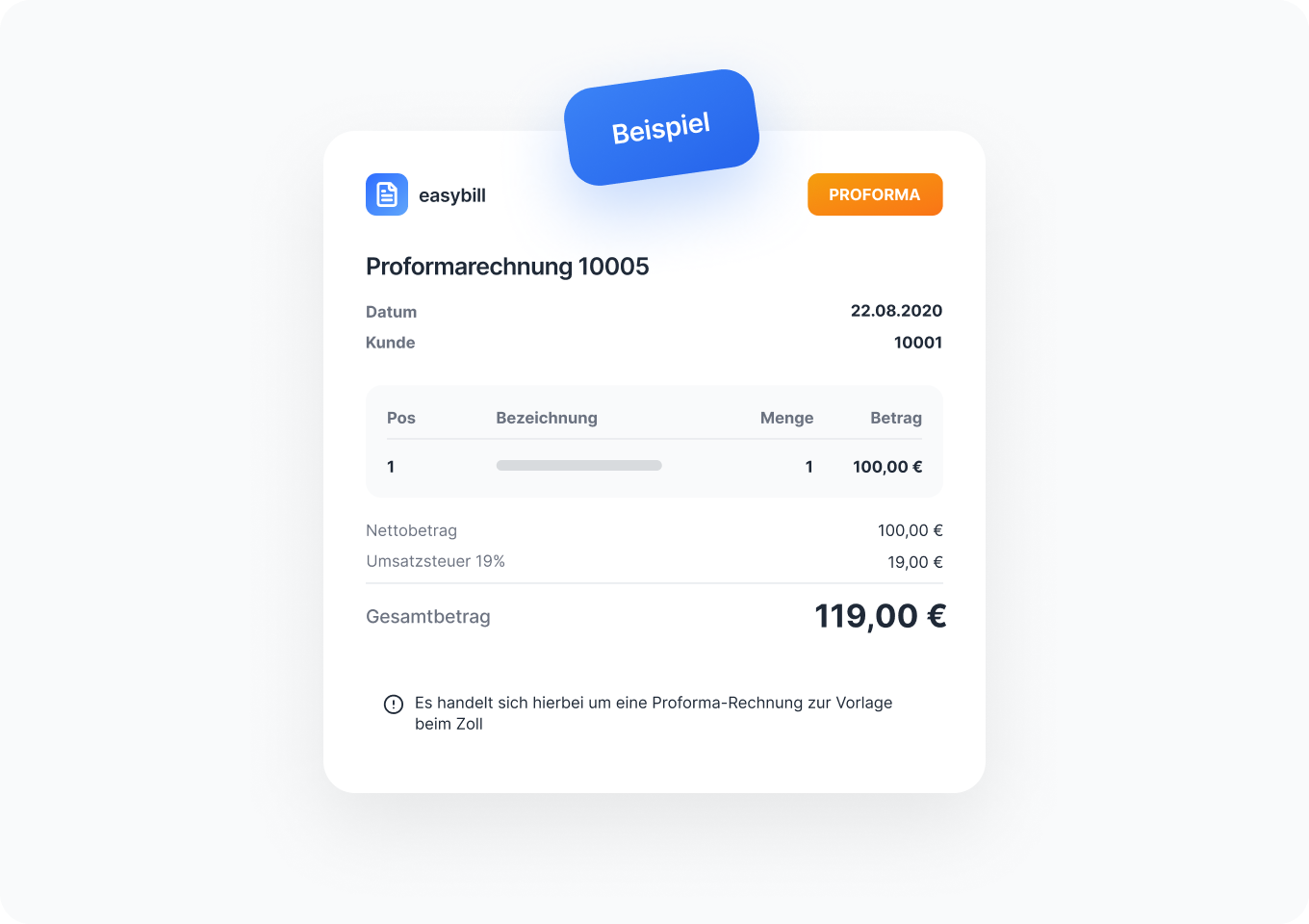
Required information in a proforma invoice
- Document title: Clearly identifiable as “Proforma invoice” or “pro forma invoice”.
- Your contact details: Name, address and other contact information of the sender. (Billing address)
- Recipient’s contact details: Including a specific contact person with telephone and fax number.
- Delivery address: This can be omitted if it is identical to the billing address.
- Invoice number, place of issue and note: Depending on the intended use, e.g., “sample delivery – value for customs purposes only”.
- Delivery and service date: When the goods were delivered or the services were provided.
- Description of the goods and quantity: A clear description of the items delivered or services provided.
- Unit and total price: Itemized and totaled costs.
- Your VAT ID: For tax purposes.
- Commercial register number and EORI number: If available and required.
- Packaging, insurance and transport costs: If applicable.
- Delivery terms: The conditions under which the delivery is made.
Tip: Use pro forma invoice templates for free
The right template for every use case: Download our free pro forma invoice template now!
The importance of the pro forma invoice in the customs process
Pro forma invoice for customs: What do you need to consider?
In international trade, the pro forma invoice is an important document that helps with customs clearance. It is used to correctly document the value of the goods and to meet customs requirements.
Requirements and regulations
Depending on the country of destination, different requirements may apply to the pro forma invoice. It is important to observe these country-specific regulations to avoid delays or problems with customs processing.
Safety first: Create a pro forma invoice with easybill
Creating a pro forma invoice can be complicated – and mistakes can be costly. Avoid risks and create your pro forma invoices with easybill. Our invoicing software helps you meet all important requirements and avoid problems with customs or tax.
Pro forma invoices must be created correctly and in a legally compliant manner
Pro forma invoices are a versatile tool for self-employed professionals, companies, and accountants. They offer clear advantages when documenting the value of goods, especially in international transactions. By using them correctly, you can meet customs requirements and streamline accounting processes. Use modern software solutions such as easybill to efficiently create and manage your pro forma invoices.
Frequently asked questions about the pro forma invoice
No, a pro forma invoice is not a real invoice in the sense of a request for payment. It is only used for documentation purposes and is not legally binding.
No, a pro forma invoice is not intended to request payment. It merely states the value of the goods.
While a cost estimate is an estimate of costs, a pro forma invoice documents the value of the goods actually shipped, without requesting payment.
Yes, it is advisable to keep pro forma invoices, especially for accounting purposes and to meet customs requirements.
A pro forma invoice should not be used when a legally binding request for payment is required. In this case, a commercial invoice is necessary.
Yes, a pro forma invoice can also be issued for services. In this case, it serves to give the customer an overview of the expected costs without constituting a binding request for payment. Especially in international business, a pro forma invoice for services can be helpful in clarifying the terms and scope of the service in advance.