
A functioning dunning process is a key component of sound financial management for freelancers, founders, and small businesses. Because unpaid invoices don’t just cause hassle—they also jeopardize liquidity in the long run. That makes it all the more important to proceed in a structured and legally compliant way when payments are not made and you have to send a payment reminder or write a reminder notice .
This article shows you what to pay attention to, how the dunning process works, and which legal basics you need to know.
Payment reminder or reminder notice? The subtle but crucial difference
A payment reminder is essentially a polite message to the customer that an invoice is due and has not yet been paid. It has no legal effect and mainly serves to avoid straining the relationship with the customer right away. Especially in long-standing business relationships, it is often the first step.
A reminder notice, on the other hand, is a legally relevant step. It documents the payment default and, in many cases, is a prerequisite for you to be able to claim default interest or reminder fees. It also forms the basis for later legal action, up to and including court dunning proceedings.
Create reminder notices automatically with easybill
easybill is a cloud-based invoicing program that helps you manage your invoices professionally, legally compliant, and time-efficiently—and automatically creates reminder notices for you.
When may or must you send a reminder notice? The legal basis
The most important legal provisions for dunning result from the German Civil Code (BGB) and the German Commercial Code (HGB). Here are the key rules:
Due date
Invoices are generally due immediately unless a payment term has been agreed. Many business owners specify a concrete date or a period of 7, 14, or 30 days. Without such information, the invoice is due directly upon receipt. Source: § 271 BGB
Default by the debtor
Under § 286 BGB , a debtor is in default if they do not pay despite the due date and you request payment—this is the classic reminder notice.
However, there are exceptions:
- If an exact payment date is specified in the contract, no reminder notice is required.
- If the debtor expressly refuses to pay, no reminder notice is required either.
- In the case of monetary claims, the debtor is automatically in default no later than 30 days after receipt of the invoice—without a reminder notice. This applies without restriction in the B2B sector, but for consumers only if you have explicitly informed them of this legal consequence.
Default interest
As soon as the debtor is in default, you may charge default interest under Section 288 of the German Civil Code (BGB):
- In commercial transactions: 9 percentage points above the base interest rate
- For consumers: 5 percentage points above the base interest rate
Damages for default
In addition to interest, you can also claim a flat fee of 40 euros from business customers. This rule from Section 285 BGB applies only in a B2B context.
Default interest in commercial transactions
Section 353 of the German Commercial Code (HGB) allows you to claim interest from the first day of default, even without a reminder, when merchants transact with each other.
How to set up an effective dunning process step by step
A clearly structured process helps you avoid payment defaults while communicating professionally at the same time. The process can be divided into several stages. This approach is not mandatory, but it has proven effective in giving your customers a chance to settle their outstanding payments within certain deadlines.
- Payment reminder
About 7 to 10 days after the due date, you can send the customer a friendly reminder. The tone is still accommodating, and the focus is on the note that the payment was probably overlooked. - First reminder
About a week after the reminder, the first reminder follows. The tone is factual but firm. You set a new payment deadline and announce default interest. - Second reminder
If no payment is made in response to the first reminder either, the tone becomes more formal. You refer to the previous reminders and clearly point out possible legal consequences. - Final reminder / Notice of legal action
In the third and final reminder, you announce measures such as a judicial dunning procedure or debt collection proceedings. This puts the customer definitively in default and paves the way to enforce your claim.
What a reminder should include
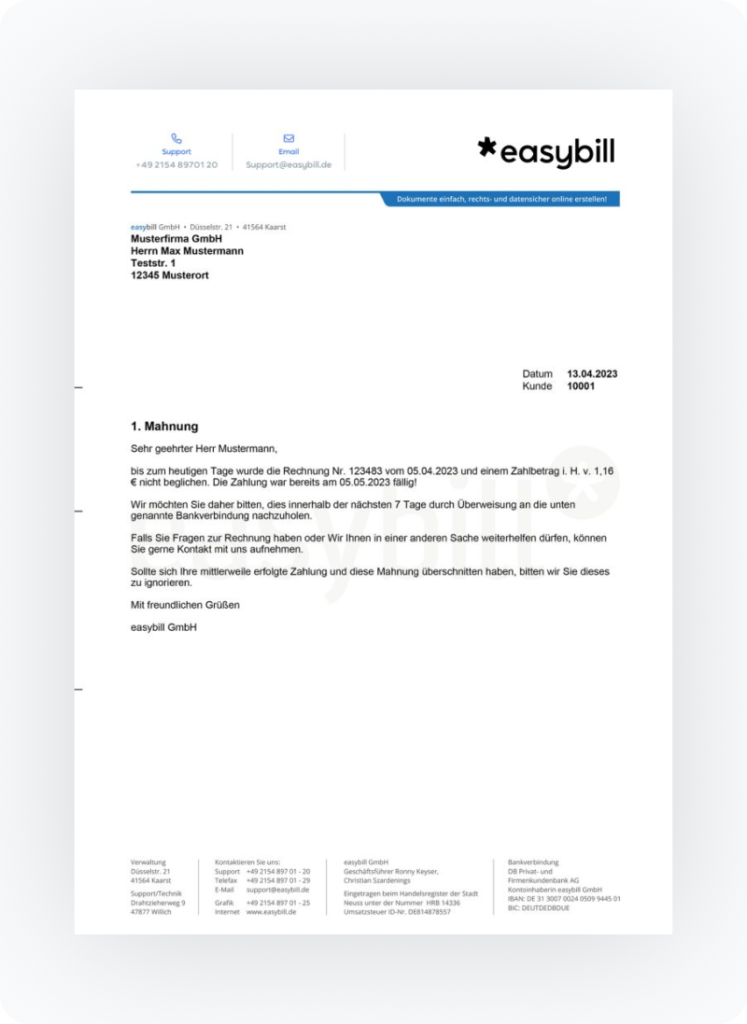
Unlike an invoice, there are no statutory mandatory details for a reminder. However, for it to be effective and to serve as evidence in the event of a dispute, it should contain the following information:
- The date and invoice number of the original invoice
- The amount due
- The original due date
- A new, specific payment deadline
- A note about default interest and possible reminder fees
- Your bank details
- A factual but clear note about the legal consequences in the event of continued late payment
Important: PDF templates can only be used to a limited extent due to the e-invoicing obligation from 2025. From then on, structured electronic invoices will be mandatory in B2B. Reminders can also be integrated into this digital standard.
Which reminder fees and interest are permitted?
In practice, the question often arises as to what you may claim in addition to the principal claim. The following rules apply:
- Default interest: It may be charged once default occurs, including retroactively. The rate is governed by Section 288 BGB.
- Dunning fees: You may charge the actual costs incurred within a reasonable scope. Excessive flat fees are not permitted.
- €40 flat fee: This applies only in B2B transactions and does not replace additionally charged dunning fees.
A good invoicing tool like easybill can help you calculate these amounts automatically and show them correctly.
Special cases: consumers, abroad, and partial payments
When dealing with consumers, you must explicitly point out the 30-day rule so that default occurs automatically. If this notice is missing, a reminder is required.
For international claims, the following applies: Word reminders in the customer’s language or at least in English. Also pay attention to different payment terms or legal regulations in the destination country.
For partial payments, you should always remind the customer of the outstanding remaining amount and document which installments have already been paid.
What to do if reminders are ignored?
If the third reminder also remains unanswered, you have several options:
- Engage a debt collection service provider
- Instruct a lawyer
- Judicial dunning procedure: Easy to initiate via the central dunning court, also possible online
However, these steps incur additional costs and take time. Sometimes a personal conversation or a settlement can be faster and more efficient. If a customer does not pay at all or only after repeated requests, the question also arises as to whether you want to continue working together in the future—because your time could be better invested elsewhere.
How to set up your dunning process professionally for the long term
A well-organized dunning process not only saves you time, but also hard cash. With easybill, you fully automate your dunning processes and avoid payment delays from the outset.
You no longer have to manually check which invoices are overdue. Instead, you define individual rules according to which the system automatically creates payment reminders and dunning notices.
easybill offers you a multi-stage dunning process with professional templates and legally compliant wording. Payment reminders before the due date can also be sent automatically to remind customers of outstanding invoices—especially with longer payment terms, a real advantage.
In addition, you benefit from an integrated bank account reconciliation: incoming payments are automatically allocated to the open invoices, so unnecessary reminders are avoided. And if a payment default does occur, you can hand the case over to a debt collection agency directly from easybill, including all relevant data and dunning fees.
Professional dunning with easybill:
- Multi-stage dunning processes with automatic control
- Enable payment reminders before the due date
- Send reminders directly online
- Automatic reconciliation of account and invoice
- Legally compliant templates and custom texts
- Direct interface to debt collection service providers
With easybill, you stay on top of things, communicate professionally, and safeguard your liquidity—without any installations and with a free trial period.
Communicate clearly in the event of late payment, act professionally
Late payment is unfortunately not uncommon in day-to-day business. This makes it all the more important to respond early and in a structured way and to set clear deadlines—while always remaining professional and friendly. A payment reminder, a legally compliant dunning notice, and smart escalation management help you avoid defaults and safeguard your liquidity.
If you regularly have to write payment reminders, switching to an automated system is worth it. With easybill, you can manage your dunning process professionally – and you’ll also be ideally prepared for the new mandatory e-invoicing requirement.
Frequently asked questions about dunning notices and payment reminders
No. A payment reminder is not required by law. It serves to maintain customer relationships and is often used before the first formal dunning notice. From a legal perspective, as soon as the customer is in default, you can send a dunning notice or even claim default interest directly, provided the requirements of Section 286 of the German Civil Code (BGB) are met.
There is no legal requirement for a specific number of dunning notices. Even one dunning notice may be sufficient to put the debtor in default. However, many companies use a three-stage dunning procedure to give the customer several chances to pay before further steps are taken.
As soon as an invoice is due and the amount has not been paid, you may send a dunning notice. If there is a specific payment term (e.g., “payable by 15/12/2025”), you can send a reminder directly the next day. Without a specific payment term, default occurs no later than 30 days after receipt of the invoice—for consumers, only if they were informed about this rule.
Yes. Dunning notices can be sent in any form, which means also by email. What’s important is that receipt by the recipient can be documented or traced. In practice, it is recommended to send them via an invoicing or dunning system such as easybill, as dispatch is automatically documented there.
You can charge a reasonable dunning fee for each dunning stage, provided the debtor is in default. However, the costs must be proportionate and justifiably substantiated. In practice, flat fees of 2.50 to 5 euros per dunning stage are common. The 40-euro flat-rate default charge may only be claimed once in a B2B context.
Yes, even small claims may be pursued with reminders. However, you should weigh up whether the effort and the proportionality make sense, especially with customer relationships you don’t want to strain. If you regularly invoice small amounts, an automated dunning process can help you act neutrally and efficiently.
No, there are no legally prescribed deadlines for the dunning process itself. However, you should set realistic deadlines, usually 7 to 10 days. This gives the customer time to pay and keeps open the option for you to initiate further steps promptly.
Claims arising from invoices generally become time-barred after three years (Section 195 BGB). The limitation period begins at the end of the calendar year in which the claim arose. You should enforce your claims by then at the latest.
Yes—if agreed instalments are not met, you may send a reminder and, under certain circumstances, even declare the entire remaining amount due if this has been contractually agreed. Make sure to correctly take into account payments already made and communicate transparently.