

If you require an advance payment from your customers, there are a number of legal points to consider. Unlike a conventional invoice, which is usually issued after the service has been provided, a deposit invoice is used to receive a payment for future services. Here you can find out what must be included on the deposit invoice.
This approach makes sense especially for large projects, expensive material purchases, or new customers: it protects you from non-payment and increases your planning reliability. Important to understand: you are not receiving a “loan” here, but an advance payment toward a specific transaction. As soon as you complete the project, the deposit paid is simply deducted from the final invoice.
These details must be included on your deposit invoice
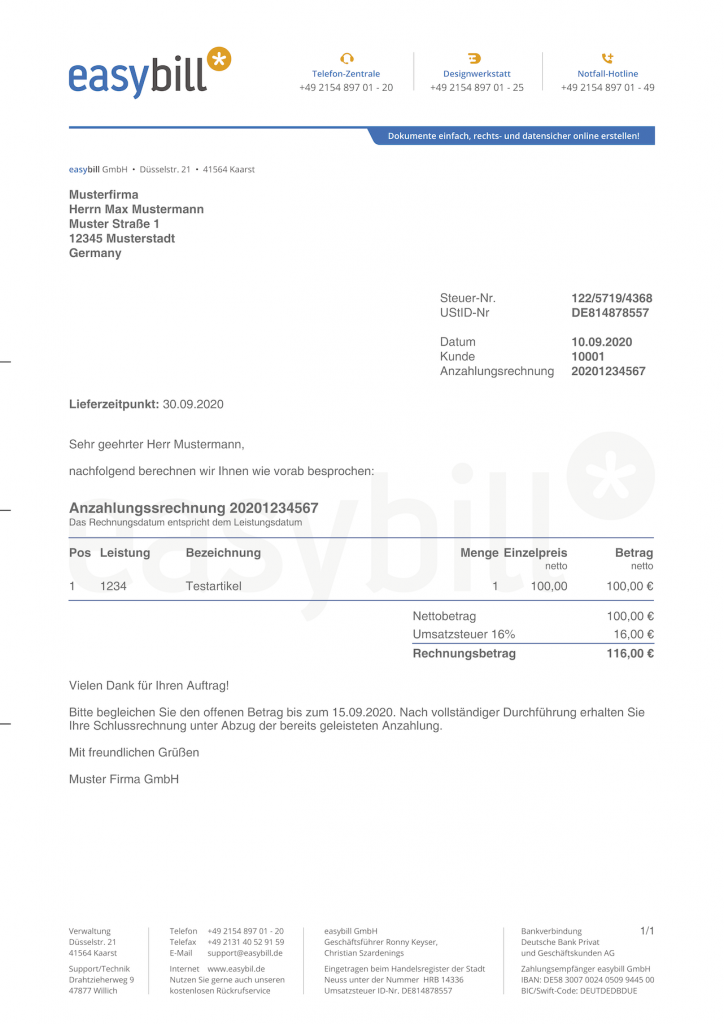
So that your customer can claim input tax deduction, the invoice must be formally correct. Since the service has not yet been provided, specific requirements apply:
- Document title: Clearly label the document as “deposit invoice” or “advance payment invoice”.
- Tax number or VAT ID no.: Your own tax number or VAT identification number.
- Full addresses: Name and address of you and your customer.
- Date & invoice number: A current issue date and a sequential, unique number.
- Description of services: Describe as precisely as possible what the deposit is being paid for (e.g., “Deposit for web design project XY”).
- Date the payment is received: Since the service will be provided in the future, you must state when the delivery or service is expected to take place. If the date has not yet been set, use wording such as “Delivery date not yet agreed”. Stating the expected calendar month in which the service will be provided is also sufficient.
- Remuneration and tax: The net amount, the applicable tax rate (e.g., 19%), the resulting tax amount, and the gross amount.
These mandatory details on an invoice apply in the same way to deposit invoices.
Input tax deduction: first the invoice, then the payment
What’s important for your customer:
The input tax deduction from a deposit is only possible if
- a proper deposit invoice is available and
- the deposit has actually been paid.
Simply receiving the invoice is not sufficient. Only once payment has been made does the customer become entitled to an input tax deduction in the amount of the VAT attributable to the deposit.
The special feature of advance payments: When the tax arises
For advance payments, VAT does not arise already when the invoice is issued, but only when the payment is received.
This applies regardless of whether you calculate VAT based on agreed remuneration (accrual taxation) or based on received remuneration (cash accounting). The only decisive factor is the actual receipt of payment. This is a major advantage for accrual taxpayers: you don’t have to pre-finance the VAT, but only remit it once the money is actually in your account.
If your customer pays only part of the requested advance payment, VAT arises only proportionately in that amount as well. This has a positive effect on your liquidity, as you only have to remit VAT on amounts you have actually received.
Important: The subsequent final invoice
After completion of the service, you must issue a final invoice. In it, the entire service is fully invoiced and the advance payment already received is correctly offset.
This means:
- The advance payment received is deducted net from the total amount.
- The tax amount attributable to the advance payment is shown separately and deducted.
- VAT is then calculated only on the remaining balance.
Example of offsetting an advance payment:
Total amount (net): €2,000
Less advance payment made (net): – €500
Subtotal (net): €1,500
Plus 19% VAT on €1,500: €285
Amount due (gross): €1,785
This ensures that VAT on the advance payment is not shown or remitted twice.
Tax rate changes between advance payment and service
For advance payments, the tax rate that applies at the time the payment is received is decisive.
For the remaining outstanding balance, however, the tax rate at the time the service is ultimately provided applies.
If the tax rate changes between the advance payment and completion, the difference is mathematically reconciled in the final invoice. The final invoice ensures that the correct total tax amount is applied overall.
Small-amount invoices and advance payments
In principle, advance payments are also possible for smaller amounts. However, simplified small-amount invoices (up to €250 gross) are only suitable to a limited extent for advance payments in practice, as they are required to contain fewer details. Especially for services not yet provided, a full invoice is therefore recommended in order to clearly document the reference to the service and when the tax arises.
Legally compliant invoices with easybill
Mandatory details, correct tax calculation, and subsequent offsetting in the final invoice require care. Especially with several advance payments, doing this manually can quickly become confusing. With easybill, this process can be automated:
- Mandatory details are prompted systematically
- Down payments remain traceable at all times
- Final invoices correctly and transparently take into account down payments made
Frequently asked questions about down payment invoices
For your customer’s input tax deduction, a proper invoice with VAT shown is required. A mere payment request is not sufficient for this.
If an order is cancelled after a down payment has been made, the original down payment invoice must be cancelled or corrected. The down payment amount is refunded, and any VAT already paid is corrected in the next VAT advance return.
In everyday language, both terms are used interchangeably. In terms of meaning, a down payment usually refers to only part of the total remuneration, while an advance payment can also cover the full amount. For VAT treatment and invoicing requirements, this makes no difference.