An outgoing invoice is the invoice you send to your customer. You use it to request payment for a delivery or service. For your bookkeeping, even more matters: the invoice documents your revenue and determines when VAT becomes due. Here you’ll learn how to post your invoices, see the accounts in SKR03 and SKR04, and find out what applies under the cash-basis method (EÜR).
Short and to the point: What is an outgoing invoice?
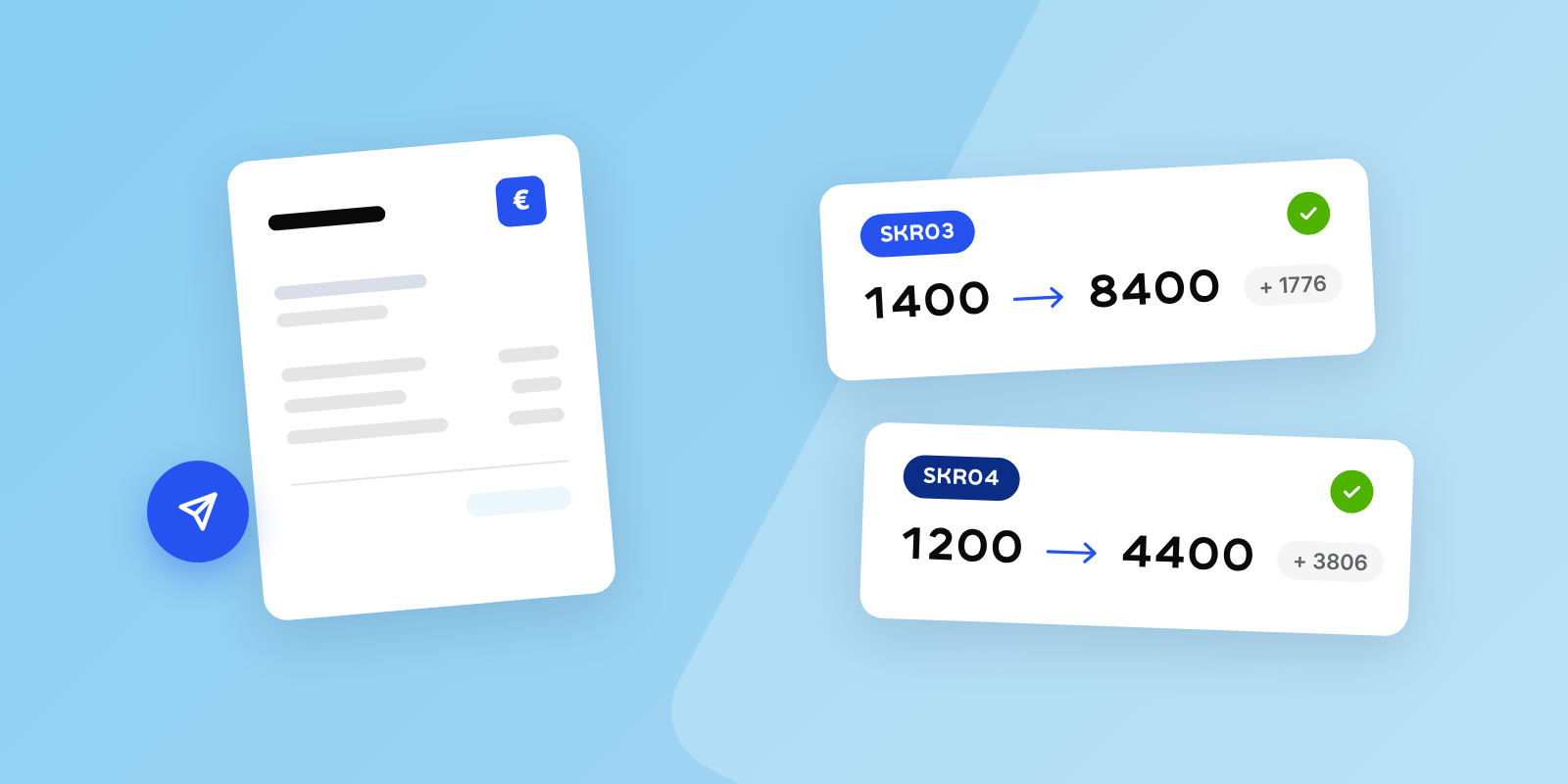
An outgoing invoice is any invoice you issue to a customer for a delivery or service. For the customer, the same invoice is an incoming invoice. If you prepare financial statements (accrual accounting), you post it as a receivable. The journal entry: receivables to revenue and VAT (SKR03 1400 to 8400 and 1776). Under the EÜR, you record the income only when payment is received. You generally report the VAT for the month in which the service is performed. Under cash accounting for VAT (Ist-Versteuerung), the month of payment is what counts.
Outgoing invoice: definition and significance
Outgoing invoices include all invoices that leave your company. You write them to customers after you have delivered goods or performed work. Other names are customer invoice, sales invoice, or Faktura.
Every customer invoice has three tasks. First, it asks the customer to pay. Second, it serves as evidence of your revenue for the tax office (Finanzamt). Third, your customer needs it to deduct input VAT (Vorsteuer). If a mandatory item is missing, they have a problem too. That’s why outgoing invoices are among the most important documents in your bookkeeping.
Incoming invoices and outgoing invoices: the difference
Whether an invoice is incoming or outgoing depends only on your perspective. The same invoice is an outgoing invoice for you. For your customer, it’s an incoming invoice. So incoming and outgoing invoices look the same; only the posting differs.
| Feature | Outgoing invoice | Incoming invoice |
|---|---|---|
| Direction | you issue the invoice | you receive the invoice |
| Counterparty | Customer (debtor) | Supplier (creditor) |
| Account | Receivables | Liabilities |
| Tax | VAT that you remit | Input VAT (Vorsteuer) that you deduct |
| Payment | Incoming payment | Outgoing payment |
Outgoing invoice as a receivable
If you prepare financial statements (accrual accounting), the invoice is a receivable. Sending it creates a trade receivable (receivable from goods and services). Your customer owes you the amount; you list them as a debtor. The receivable remains in your books until the money is in the account.
Under the EÜR, you don’t post a receivable. Even so, you should still keep a list of open items (outstanding invoices). Otherwise you’ll soon lose track.
A receivable is not cash yet. Still, tax on it may already be due. As a rule, you pay it to the tax office (Finanzamt) before your customer has paid.
Mandatory details and form of an outgoing invoice
So that your customer can deduct input VAT (Vorsteuer), the invoice must contain ten mandatory details under Section 14 UStG. In summary, these are five groups:
- Name and address of you and your customer
- your tax number or VAT ID
- issue date and a sequential, unique invoice number
- delivery or service date as well as quantity and type of service
- net amount, tax rate, tax amount, and gross amount
You can find all details in the guide to the mandatory details on an invoice. The article on the invoice number shows you how to set up number ranges properly. If you provide services to a business, a deadline applies. In that case, you must issue the invoice no later than six months after the service.
For invoices to businesses within Germany, the e-invoice is coming. Starting January 1, 2027, you must issue e-invoices if your total revenue in 2026 exceeded 800,000 euros. Starting January 1, 2028, it applies to all invoices to businesses within Germany. Small businesses (Kleinunternehmer) have an option. Invoices to private individuals are not affected. Until it becomes mandatory, you may send paper invoices. A PDF is only allowed with the customer’s consent, which can also be implicit. You can read more about this in the guide to the e-invoice obligation.
Posting an outgoing invoice: journal entry with example
An example shows the posting best. A web designer builds a website for a customer in March. On April 2, she sends the invoice: 1,500 euros net plus 285 euros VAT (19%), totaling 1,785 euros. The customer pays on May 6.
The account numbers come from DATEV’s standard charts of accounts. You can read more about both in the guide SKR03 and SKR04 charts of accounts. Your tax advisor may use different accounts. When in doubt, their specification applies.
Posting when the invoice is issued
With accrual accounting, you post the invoice as soon as you have issued it. The journal entry is: receivables to revenue and VAT. The receivable is on the debit side, revenue and tax are on the credit side.
| Debit | Credit | Amount | SKR03 | SKR04 |
|---|---|---|---|---|
| Receivables from goods and services | 1,785 euros | 1400 | 1200 | |
| Revenue 19% VAT | 1,500 euros | 8400 | 4400 | |
| VAT 19% | 285 euros | 1776 | 3806 |
In practice, each customer gets their own debtor account, usually starting at number 10000. The software collects all customers under the Receivables account. This way you can see what is still outstanding for each customer.
Posting when payment is received
On May 6, EUR 1,785 is credited to your account. Now you post bank to accounts receivable.
| Debit | Credit | Amount | SKR03 | SKR04 |
|---|---|---|---|---|
| Bank | EUR 1,785 | 1200 | 1800 | |
| Trade receivables | EUR 1,785 | 1400 | 1200 |
This settles the receivable. The open item disappears from your list. Reconcile payments with your invoices often. That way, gaps stand out quickly.
Cash-basis accounting (EÜR): you post when payment is received
Many self-employed people determine their profit using the EÜR. In that case, the inflow principle applies (§ 11 (1) EStG). Income counts in the year in which the money is received. So you don’t post a receivable, but only the payment.
| Debit | Credit | Amount | SKR03 | SKR04 |
|---|---|---|---|---|
| Bank | EUR 1,785 | 1200 | 1800 | |
| Revenue 19% VAT | EUR 1,500 | 8400 | 4400 | |
| VAT 19% | EUR 285 | 1776 | 3806 |
An example across the year-end: You issue the invoice in December 2026. The customer pays in January 2027. Then it is income for 2027. This rule does not apply for VAT. There it depends on whether you use Soll- or Ist-Versteuerung.
Posting outgoing invoices: revenue accounts by tax rate
Posting (Kontieren) means: you assign each transaction to the appropriate revenue account. Which account fits depends on the tax rate and the type of transaction. This is the only way the revenue figures will later be correct in your VAT pre-return.
| Case | Account | SKR03 | SKR04 |
|---|---|---|---|
| Sales at 19% | Revenue 19% VAT | 8400 | 4400 |
| Sales at 7% | Revenue 7% VAT | 8300 | 4300 |
| Small business (Kleinunternehmer) | Tax-exempt revenue for small businesses under § 19 (1) UStG | 8192 | 4184 |
| Reverse charge in Germany (§ 13b UStG) | Revenue from services under § 13b UStG | 8337 | 4337 |
| Cash discount to customers, 19% | Cash discounts granted 19% VAT | 8736 | 4736 |
The 7% VAT is posted to account 1771 in SKR03 and 3801 in SKR04. For small businesses, the DATEV chart of accounts 2026 has a new revenue account. Older guides still mention 8195 or 4185. These accounts are reserved today. If you grant a customer a cash discount (Skonto), the tax also decreases by the same amount.
When you post the outgoing invoice and VAT becomes due
For VAT, the invoice date is not what matters. What is decisive is whether you use Soll- or Ist-Versteuerung. That determines for which month you report it in the VAT pre-return.
Soll-Versteuerung is the standard case (§ 16 (1) UStG). The tax arises at the end of the pre-return period in which the supply/service was performed (§ 13 (1) no. 1 letter a UStG). That is the month or quarter in which you performed the service. Whether your customer has already paid is irrelevant. If the customer takes their time, you advance the VAT.
Ist-Versteuerung is available only upon application to the tax office (§ 20 UStG). Then the tax arises only when the money has been received. You file the application if your total turnover in the previous year did not exceed EUR 800,000. This threshold has applied since January 1, 2024. Freelancers can also apply for it.
This is how it affects the example, with monthly pre-returns:
| Step | Soll-Versteuerung | Ist-Versteuerung |
|---|---|---|
| Service performed | March | March |
| Invoice issued | April | April |
| Payment received | May | May |
| VAT belongs in the pre-return for | March | May |
An exception applies to advance payments. Here, the tax always arises when payment is received. This also applies under Soll-Versteuerung (§ 13 (1) no. 1 letter a sentence 4 UStG). For profit determination, a third rule applies. If you prepare financial statements (Bilanz), the revenue counts in the year of performance. Under the EÜR, the year of payment counts.
Whether Ist-Versteuerung is worthwhile for you is something you clarify with your tax advisor. A good occasion: Your customers often pay only after 30 days or later.
Outgoing invoice register: when you need one
An outgoing invoice register is a list of all invoices you have issued. In the past, this was often an actual paper book. There is no law that requires a separate book with this specific name.
What is mandatory, however, are the recordkeeping requirements under § 22 UStG. Your records must show the agreed consideration, separated by tax rates and VAT-exempt supplies. The tax office is not allowed to require an extra list for this. Condition: Everything can be easily verified from the bookkeeping (Section 22.2 UStAE).
In practice, a clean invoice list is sufficient. For each invoice, it includes:
- Invoice number and date
- Customer name
- Net amount, tax rate, and tax
- Status: open or paid
Make sure invoice numbers are consecutive with no gaps. Gaps stand out in a tax audit and require an explanation. A separate guide shows you how to manage open items. Are you a wholesaler and do you deliver goods to other companies? Then you also record goods issues (§ 144 AO).
Special forms of outgoing invoices
A small-amount invoice up to EUR 250 gross requires fewer details (§ 33 UStDV). You do not need the customer’s address or an invoice number there.
With a down payment invoice, you invoice parts of a large order in advance. Here, the tax is incurred upon payment. In the final invoice, you deduct the down payments again.
Under the reverse-charge procedure, your customer owes the VAT. You do not show any tax and include the note “Steuerschuldnerschaft des Leistungsempfängers” on the invoice. For domestic cases under § 13b UStG, there is a separate revenue account (SKR03 8337, SKR04 4337). One example is construction services provided to construction companies.
If you use the small business scheme, you do not show any tax. Instead, the invoice includes a note such as “Gemäß § 19 UStG wird keine Umsatzsteuer berechnet”. All other information remains the same.
Unpaid or incorrect sales invoice: what to do
If a customer doesn’t pay, first send a friendly payment reminder. If the money still doesn’t come in, follow up with a dunning notice. Your list of outstanding items shows you when it’s time.
As an accrual-basis taxpayer (Soll-Versteuerer), you’ve usually already paid the tax. You can only reclaim it once the receivable has become uncollectible (§ 17 Abs. 2 Nr. 1 UStG). This is the case, for example, after the customer’s insolvency. A mere late payment is not enough. You then post the loss to bad debt losses (SKR03 2406, SKR04 6936). It’s best to discuss with your tax advisor whether a receivable is truly lost.
If a required detail is missing or incorrect, you correct the invoice. Alternatively, you cancel it and issue a new one. The guides on invoice correction and on the cancellation invoice show you how. If you show too much tax, you owe the amount to the tax office. This applies until you have corrected the invoice (§ 14c Abs. 1 UStG).
Create and manage sales invoices with easybill
With easybill, you can write invoices with all required details and a sequential number. If you wish, you can create them as e-invoices in the XRechnung or ZUGFeRD format. A payment link via Mollie helps your customer pay right away.
The automatic payment matching assigns each payment in your account to the correct invoice. This way, you can see at any time what is still outstanding. In the Premium plan, the dunning system automatically sends reminders.
For your tax advisor, you export the invoices with all posting data via the DATEV interface. Exports for Lexware Office and other programs are also available. easybill archives your invoices in compliance with GoBD. That’s important. Since 2025, you must keep invoices for eight years, and e-invoices in the original format as XML. Details can be found in the guide to the retention periods.
Frequently Asked Questions & Answers About Sales Invoices
Neither. Debtors and creditors are people, not invoices. Whoever receives your invoice is your debtor, i.e., your obligor. The unpaid invoice appears as a receivable in your books. Creditors are your suppliers, to whom you owe money. In bookkeeping, each customer and each supplier has their own account. This lets you see who owes whom how much.
As a rule, yes. Under accrual accounting for VAT (Soll-Versteuerung), what counts is the month or quarter in which the service was performed. The tax is incurred when that period ends. The customer’s payment is irrelevant for this. It’s different under cash accounting for VAT (Ist-Versteuerung). Then you declare the tax only once the money has been received. You apply for this with the tax office. This is possible up to a total turnover of 800,000 euros in the previous year. Self-employed professionals (Freiberufler) can also apply.
You must keep invoices and other accounting documents for eight years since 2025; previously it was ten. This applies to your own invoices as well as those from suppliers. The period begins at the end of the year in which you issued the invoice. An invoice from March 2026 may therefore be deleted at the earliest at the beginning of 2035. You must keep e-invoices in their original form, i.e., as an XML file. If a tax audit is ongoing, the period is extended.
That depends on your revenue. If your total turnover in calendar year 2026 was above 800,000 euros, you must issue e-invoices to businesses in Germany starting January 1, 2027. From January 1, 2028, it applies to everyone. Small business owners (Kleinunternehmer) may continue to use paper or PDF. Invoices to private individuals (B2B) are not affected. However, you have already been required to receive e-invoices since January 1, 2025.
You don’t simply change an invoice you have sent in the file. Otherwise, your copy and your customer’s copy will no longer match. If a required detail is missing, you send a correction that clearly refers to the old invoice. In the case of major errors, you cancel the invoice and issue a new one with a new number. If too much tax was shown on the invoice, you owe it. This applies until you have corrected the invoice.
This article is for general information and does not replace tax advice.