
Anyone who sells goods or services to businesses in other EU countries reports these transactions to the German Federal Central Tax Office (Bundeszentralamt für Steuern, BZSt) via the Recapitulative Statement (Zusammenfassende Meldung, ZM). This applies to the merchant with B2B customers in France just as much as to the agency with a client in Austria or the Amazon seller who ships goods to a warehouse in Poland. This article shows you who must report, which deadline applies, what belongs in the statement, and how to correct errors.
In brief: The Recapitulative Statement (Zusammenfassende Meldung, ZM) under § 18a UStG lists your VAT-exempt supplies, transfers, triangulation transactions, and other services to businesses in other EU Member States—per customer, with VAT ID number and amount. You submit it electronically to the BZSt by the 25th day after the end of the reporting period. If your supplies of goods exceed EUR 50,000 per quarter, you report monthly; otherwise, quarterly.
Recapitulative Statement under § 18a UStG: definition and purpose
The ZM is a VAT statement governed by § 18a UStG. With it, you show the BZSt which businesses in other EU Member States you supplied VAT-exempt goods to or for which you provided services. In practice it is often called the “ZM statement,” meaning the same thing.
The purpose is control. You do not charge your customer in France German VAT; instead, they pay tax on the purchase in their country. The BZSt forwards your information to the other Member States. There, it is checked whether your customer has also declared the acquisition. Without this exchange of data, the VAT exemption in the EU internal market would be difficult to monitor.
Who must file the Recapitulative Statement
The obligation applies to any business liable for VAT that had at least one of the following transactions during the reporting period:
- an intra-Community supply to a business with a VAT ID number in another EU Member State
- another service to an EU business for which the customer owes the tax in their country
- a supply as the intermediary entrepreneur in an intra-Community triangulation transaction
- a transfer of your own goods to another EU Member State
- a supply into a call-off stock warehouse in another EU country
The statement is not just a formality. Since 2020, an intra-Community supply is VAT-exempt only if you have correctly reported it in the Recapitulative Statement (§ 4 no. 1 b UStG). If the statement is missing or incorrect, the tax office can retroactively deny the tax exemption. You would then owe German VAT on a transaction for which you did not charge any.
Small businesses and the ZM
Small businesses under § 19 UStG do not file a Recapitulative Statement; § 18a(4) UStG expressly provides for this. A VAT ID number alone does not change that. Many small businesses apply for it for EU purchases or services from abroad; this does not create a reporting obligation. Our article on the small business scheme explains which turnover thresholds apply from 2025.
VAT groups (Organschaft) and the ZM
In a VAT group (umsatzsteuerliche Organschaft), the controlling entity (Organträger) declares the transactions of all companies in its advance VAT return. This does not apply to the Recapitulative Statement. Each group company (Organgesellschaft) with reportable EU transactions files its own Recapitulative Statement under its own VAT ID number. If in doubt, have the allocation reviewed by your tax advisor.
Which transactions belong in the Recapitulative Statement
Only outbound transactions to businesses in other EU Member States are reported. Each type of transaction follows its own logic regarding the VAT ID number and reporting period.
| Type of transaction | Example | Which VAT ID number | Reporting period |
|---|---|---|---|
| Intra-Community supply | You sell 200 office chairs to a dealer in Lyon | your customer’s | Month or quarter of the invoice |
| Other service | Your agency supports a customer in Vienna | your customer’s | Period of performance |
| Triangulation transaction | You buy in Italy and sell to Spain; the goods are shipped directly | the final customer’s, marked as a triangulation transaction | Period of performance |
| Transfer | You ship your own goods to a warehouse in Poland | your own in the country of destination | Month or quarter of the invoice |
| Call-off stock warehouse | Goods are stored at the customer’s site in the Netherlands on call-off basis | the intended acquirer’s | according to the call-off stock rules |
For services to EU businesses, the VAT liability is shifted to your customer. Your invoice then contains no VAT, but rather a note regarding the tax liability of the recipient of the service. We explain separately how the reverse-charge procedure works and what § 13b UStG provides for services from abroad. For the Recapitulative Statement, the only thing that matters is this: The service to the EU customer must be included.
What does not belong in the ZM
Purchases from other EU countries—i.e., intra-Community acquisitions—are not included in the ZM. You declare them in the advance VAT return. Also excluded are supplies to a third country such as Switzerland or the United States, sales to private customers in the EU, and, since Brexit, all transactions with Great Britain.
An exception applies to Northern Ireland: because Northern Ireland continues to be part of the EU VAT territory after Brexit, supplies of goods to Northern Ireland are still treated like EU supplies and must be included in the Recapitulative Statement. Other services to businesses in Northern Ireland, however, are excluded and are treated as third-country transactions.
Transfers to an EU warehouse: Amazon FBA and the ZM
Anyone selling via Amazon FBA and shipping goods to warehouses in Poland or the Czech Republic is transferring them within the EU. For VAT purposes, this is an intra-Community supply to yourself (§ 3(1a) and § 6a(2) UStG). There is no buyer and no invoice to a third party; nevertheless, the transaction must be included in the Recapitulative Statement.
It is reported using your own VAT ID number from the country of destination. This means: anyone who transfers goods permanently to an EU warehouse needs a VAT registration there and their own number.
The difference from a normal supply lies in the recipient: with an intra-Community supply, the goods go to another business; with a transfer, they remain yours. Because warehouse movements between multiple countries can quickly become confusing, you should define the reporting logic for your countries once with your tax advisor.
Deadline and reporting period: monthly, quarterly, or annually
The Recapitulative Statement is due on the 25th day after the end of the reporting period. Which reporting period applies to you depends on the volume of your supplies of goods.
| Reporting period | Requirement | Deadline |
|---|---|---|
| quarterly | Goods supplies and triangulation transactions not exceeding EUR 50,000 in the current quarter and in each of the four preceding quarters | April 25, July 25, October 25, January 25 |
| monthly | more than EUR 50,000 in any one of these quarters | 25th of the following month |
| annually (annual report) | no VAT advance return required, total turnover not exceeding EUR 200,000 and EU supplies not exceeding EUR 15,000, each in the previous year and expected in the current year, no supply of new vehicles | January 25 of the following year |
The EUR 50,000 threshold is often called a de minimis threshold. Only goods supplies and triangulation transactions count toward the threshold. You generally report services quarterly. If you report monthly, you can include them monthly as well.
If you exceed the threshold in the middle of a quarter, you switch immediately. An example from the BZSt: A merchant supplies EUR 20,000 to the EU in April and EUR 37,000 in May. At EUR 57,000, he is above the threshold in May. He reports April and May together by June 25, and from June onward then every month. He does not receive a notification from the BZSt for this.
If the 25th falls on a weekend or a public holiday, the deadline is moved to the next business day (§ 108 para. 3 AO). There is no standing deadline extension (Dauerfristverlängerung) for the ZM like the one you may know from the VAT advance return. An extension in an individual case is only possible upon a substantiated request to the BZSt, and it must be filed before the deadline expires.
Invoice date or supply date: which month counts
For goods supplies and transfers, the invoice date is decisive. You report the turnover in the period in which you issue the invoice. There is an upper limit: at the latest, it must be in the period in which the month after the supply ends (§ 18a para. 8 UStG).
Example: You deliver to Belgium on March 28 and issue the invoice on May 3. As a monthly filer, the supply belongs in the ZM for April, because April is the month after the supply. The invoice in May comes too late to shift the reporting period.
For services and triangulation transactions, the supply date counts, i.e., the point in time when you performed the service. The invoice date does not matter here.
Cash accounting (Ist-Versteuerung)
If you are taxed on the basis of payments received, that does not change anything for the ZM. For the report, neither the receipt of payment nor the month in which you remit VAT is relevant. Cash accounting affects only your VAT advance return; the recapitulative statement always follows the rules above.
Credit notes, cancellations, and advance payments in the ZM
Subsequent changes to the price are not errors. If you grant an EU customer a discount, they take a cash discount (Skonto), or you cancel part of the supply, you report the change in the period in which it occurs. The original recapitulative statement remains unchanged.
You offset the change against the transactions with the same customer in that period. Example from the BZSt: In June, you supply EUR 80,000 to a customer in Austria and, in the same month, grant them a EUR 5,000 reduction for an earlier supply. The ZM for June will then show EUR 75,000. If there is no new transaction with this customer in the month of the credit note, you report a negative amount with a minus sign.
You do not report an advance payment for a goods supply in advance. The recapitulative statement follows the invoice for the supply and/or the time of performance. The same applies to partial payments: What matters is the invoice for the supply performed, not the receipt of funds.
Filing the recapitulative statement: step by step via ELSTER or the BZSt online portal
The report is submitted exclusively electronically to the BZSt, not to your local tax office (Finanzamt). You have two options: ELSTER, which works for most businesses, or the BZSt online portal (BOP). Proceed as follows:
Set up access. Register once with ELSTER or in the BOP. In the BOP, you additionally need to register for the ZM specialist procedure.
Open the form. Select the “Recapitulative statement” form.
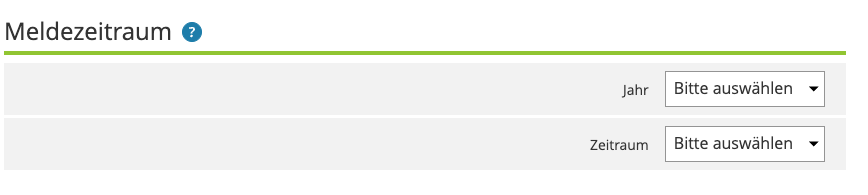
Set the reporting period. Enter the month, quarter, or calendar year you are reporting for.
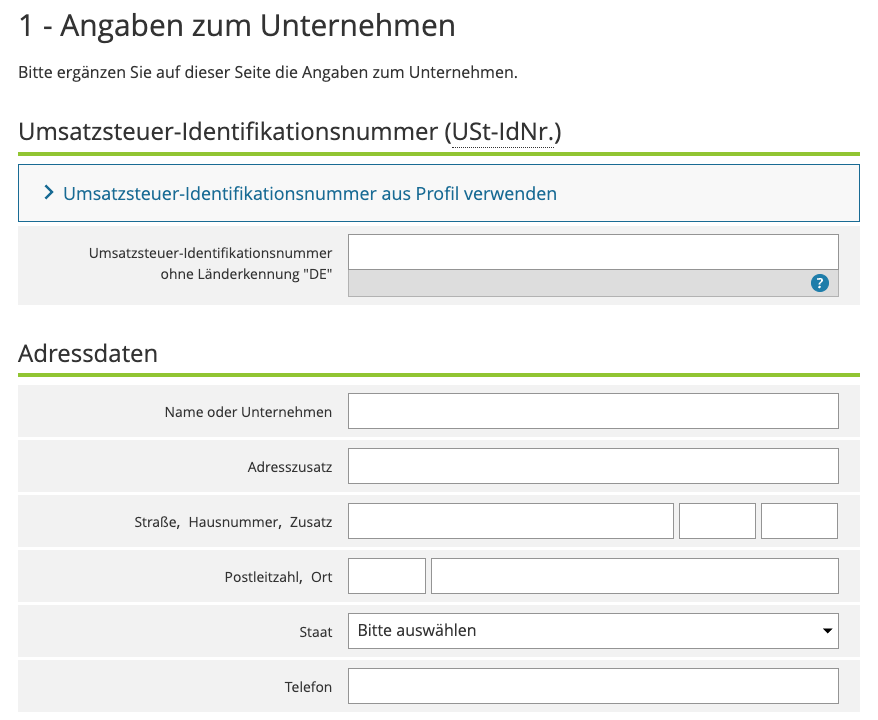
Enter your details. Enter your own VAT ID (USt-IdNr.) and address details.
Record transactions. Create one line per customer: VAT ID with country code, total taxable amounts in euros, and type of transaction (goods supply, other service, or triangulation transaction). Consolidate multiple invoices to the same customer into one amount.
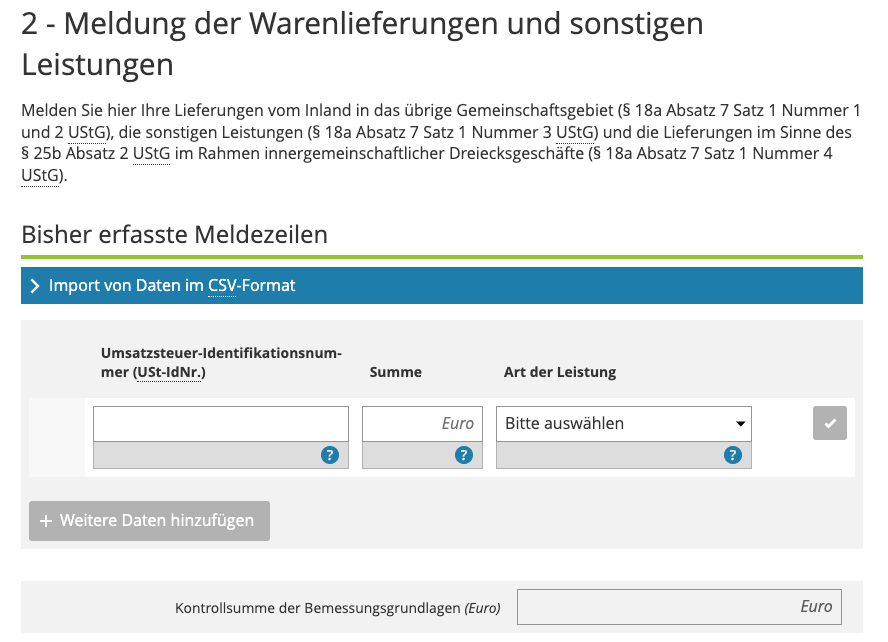
Import data instead of typing it in. If you have many customers, upload a CSV file into the online form. Invoicing programs and accounting software usually provide this file directly.
Submit and save the protocol. Transmit the report by the 25th and keep the submission confirmation with your records.
Anyone reporting more than 1,500 lines or submitting for multiple businesses uses the ELMA5 interface, which is only available in the BOP. A paper form is available only in exceptional cases: Upon request, the tax office (Finanzamt) can permit you to report on paper if electronic transmission cannot reasonably be expected of you. Even then, the report itself is submitted to the BZSt.
Zero report: no ZM without EU transactions
If you had no reportable transactions in a reporting period, you do not file a ZM. A zero report is not предусмотр, so you do not have to transmit a ZM with 0. This is what distinguishes the recapitulative statement from the VAT advance return, which you file even without transactions. You only need the amount 0 in the ZM for a correction, to cancel an incorrect line.
Correcting the ZM: rectify errors within one month
If you discover that a recapitulative statement you have submitted is incorrect or incomplete, you must correct it within one month (Section 18a (10) UStG). The deadline runs from the day you recognize the error. The correction has retroactive effect: you correct the original reporting period, not the current one.
For each affected period, you submit a separate corrected recapitulative statement via ELSTER or the BOP and tick the checkbox there for the correction. You do not repeat lines that were reported correctly. The BZSt distinguishes five cases:
| Error | How to correct it |
|---|---|
| Revenue missing | Report only the missing revenue subsequently |
| Incorrect reporting period | In the incorrect period, cancel the line with EUR 0; report it again in the correct period |
| Incorrect VAT ID no. | Cancel the incorrect number with EUR 0; report the revenue under the correct number |
| Incorrect amount | Report one line with the correct total amount, not just the difference |
| Incorrect type of transaction | Cancel the line with EUR 0; report the revenue again with the correct type |
A timely correction prevents a fine and safeguards the VAT exemption for your supplies.
ZM filed late or forgotten: what you could face
If you file the ZM late or forget it, the BZSt responds in stages. First comes a reminder, then the threat of a coercive penalty payment (Zwangsgeld), and finally its assessment. The Zwangsgeld is intended to force submission. Even if you pay it, the statement is still due.
In addition, the BZSt may impose an административ fine of up to EUR 5,000 (Section 26a UStG). This applies to a recapitulative statement that was not submitted, or was submitted incorrectly, incompletely, or late, or was not corrected in time. The most expensive penalty is often a different one: if the supply is missing from the ZM, the VAT exemption may be denied and you will have to pay the VAT yourself.
There is no late-filing surcharge for the ZM. Many guides still mention a surcharge of up to EUR 2,500. However, the applicable Section 18a (11) UStG explicitly excludes the provision on late-filing surcharges (Section 152 AO) for the ZM (as of 2026). If you missed a deadline, submit the statement immediately. The sooner it reaches the BZSt, the lower the risk.
Common mistakes with the ZM
Most mistakes don’t arise during transmission, but earlier in the invoice data. These seven are the most common in practice:
- The customer’s VAT ID no. is invalid or missing. Check it with the BZSt before the first supply. What you need to keep in mind is explained in our article on tax number and VAT ID no..
- The transfer to your own warehouse in another EU country is missing from the statement.
- Purchases from other EU countries are mistakenly included.
- The deadline is calculated based on the permanent deadline extension (Dauerfristverlängerung) for the advance VAT return.
- A discount or cancellation is reported as a correction of the old recapitulative statement instead of in the current period.
- The figures in the ZM and the advance VAT return do not match.
- The switch to monthly filing after exceeding EUR 50,000 is overlooked.
ZM, advance VAT return, Intrastat, and OSS compared
Anyone selling in the EU often has several filings at the same time. The four complement each other; none replaces another.
| Filing | Recipient | Content | Deadline |
|---|---|---|---|
| ZM | BZSt | B2B transactions within the EU by customer, transfers | 25th day after the reporting period |
| Advance VAT return | Tax office (Finanzamt) | all sales and input VAT, EU transactions shown separately | 10th day after the advance return period, permanent deadline extension possible |
| Intrastat | Federal Statistical Office | movements of goods for foreign trade statistics | monthly, only above your own value thresholds |
| OSS | BZSt | sales to private customers in other EU states | quarterly |
The advance VAT return and the ZM must match. Under Section 18b UStG, you report your EU supplies, services to EU businesses, and triangulation transactions separately in the advance return, following the same period rule as in the ZM. If the totals differ, check both filings before you submit them.
Intrastat is purely statistical and has nothing to do with VAT. The obligation only begins once certain annual values are reached for goods movements. The One-Stop-Shop does not replace the ZM either: via OSS you report sales to private customers; via the ZM you report sales to businesses and transfers. If you sell to both groups, you submit both filings.
ZM in English: EC Sales List and recapitulative statement
In English, the ZM is usually called the “EC Sales List,” abbreviated ESL. The term comes from the UK and is still widespread today in software, marketplace reports, and international teams. EU documents, by contrast, use “recapitulative statement.” Both refer to the same report of intra-Community transactions to the tax authority. If you work with English-language bookkeeping or download VAT reports from Amazon, you will often find the relevant data under one of these terms.
Automatically preparing ZM data from Amazon, eBay, and Shopify
All information for the ZM is already on your invoices: the customer’s VAT ID no., the invoice date, the country of supply, and the net amount. The cleaner these data are created, the faster the filing is done.
easybill Connect creates invoices automatically when you import your orders from Amazon, eBay, Shopify, and other marketplaces and shops. In the process, the software maps tax logic such as OSS and storage abroad. Via the DATEV interface, the postings go directly to your tax advisor. What this looks like in day-to-day practice is shown on our page about e-commerce accounting with easybill.
Frequently asked questions & answers about the recapitulative statement
No. The Recapitulative Statement only covers your sales and services to businesses in other EU Member States, as well as transfers of your own goods. If you purchase goods from a supplier in another EU country, that is an intra-Community acquisition. You report this in your VAT advance return, not in the ZM. The supply is reported by your supplier, in their own country.
No. The permanent deadline extension only shifts the deadline for the VAT advance return by one month. For the Recapitulative Statement, the deadline remains the 25th day after the end of the reporting period. So if you have a permanent deadline extension for the advance return, you must submit the ZM significantly earlier than the advance return for the same month. You can apply to the BZSt for an extension in an individual case only with a justification, before the deadline expires.
Then the deadline ends on the next business day. If the 25th falls on a Saturday, submission is sufficient until Monday, the 27th. The same applies to statutory public holidays. The rule comes from Section 108 (3) AO and applies to the Recapitulative Statement as it does to other tax filings. Still, don’t rely on the last day, because technical problems with transmission do not extend the deadline.
One month from the day you notice the error (Section 18a (10) UStG). You correct the original reporting period and re-report only the incorrect lines. You cancel incorrect lines by reporting an amount of 0 euros. If you meet the deadline, you secure the VAT exemption for your supplies and avoid a fine of up to 5,000 euros.