
Since 2025, all companies must be able to receive electronic invoices; by no later than 2028, every B2B invoice within Germany must be created and archived in the e-invoice format. This article shows how to make the switch easily.
What is an e-invoice?
The e-invoice is a structured electronic invoice that is machine-readable. It is based on the European standard EN 16931, which specifies which data must be included and how it must be structured technically. In Germany, e-invoicing will become mandatory in stages starting in 2025. From 2028 onwards, invoices may only be issued as electronic invoices.
Important: A PDF is not a machine-readable electronic invoice. Anyone who has previously created invoices in Word or Excel and printed them as a PDF must switch to e-invoicing software by no later than 2028.
What applies in 2026?
2026 is a transition year; companies are intended to be given time to adapt to the e-invoicing requirement and adjust their processes. Companies must already be able to receive, process, and archive e-invoices.
A general obligation to send only structured e-invoices does not yet apply across the board in 2026, as long as the recipient agrees and transitional periods apply. PDFs and other formats are still possible during the transition period, but they do not meet the definition of an e-invoice.
Digital invoice vs. electronic invoice vs. e-invoice
| Term | Meaning |
|---|---|
| Digital invoice | e.g. PDF or scan – not structured, not machine-readable |
| Electronic invoice | Umbrella term for invoices that are sent electronically |
| E-invoice | Structured, standardized data format (e.g. XML) in accordance with EN 16931 |
In the future, only the e-invoice as defined by the standard will be permitted. A PDF invoice will no longer be sufficient, even if it is sent by email. That’s why every company and self-employed person needs to address the topic and prepare for the changeover.
From when is e-invoicing mandatory?
Overview of all key dates (2025–2028)
| Year | What applies? |
|---|---|
| 2025 | Receiving requirement: From 01/01/2025, all businesses and associations must be able to receive and process structured e-invoices. |
| 2025–2026 | Transitional rule: Issuing other invoices (e.g. paper or PDF) remains permitted—if the recipient agrees. |
| 2027 | Issuance requirement: Companies with prior-year revenue (2026) of more than €800,000 must issue e-invoices. Companies with lower revenue may continue to send other invoices. |
| 2028 | Mandatory for all: From 01/01/2028, all domestic B2B invoices must be issued as an e-invoice. Other formats (e.g. PDF) will then no longer be permitted. |
Note: The e-invoicing obligation from 2028 applies to all regular domestic B2B invoices.
Exceptions include, among others, small-amount invoices (§ 33 UStDV) and tax-exempt supplies under § 4 No. 8 to 29 UStG (e.g. healthcare services or renting).
Who is affected by the mandatory e-invoicing requirement?
In principle, the following are affected:
- All entrepreneurs within the meaning of Section 2 UStG
- for domestic B2B transactions
- if the recipient of the service is also an entrepreneur
Regardless of:
- Legal form (sole proprietorship, GmbH, association, etc.)
- Size
- Application of the small business regulation (Section 19 UStG)
The following are not subject to the requirement:
- Invoices to private individuals (B2C)
- Small-amount invoices up to €250 (Section 33 UStDV)
- Tickets (Section 34 UStDV)
- Certain tax-exempt transactions under Section 4 Nos. 8–29 UStG
- Transactions not taxable domestically
Benefits of e-invoicing: automation and cost reduction
Switching to e-invoicing may initially seem like an obligation, but it offers companies significant advantages in terms of efficiency, costs, and future-proofing. The key benefit lies in the structured data basis, which enables comprehensive automation of processes.
“All data comes out of the invoicing tools in a structured and therefore standardized way. This enables the long-awaited automation. In accounting, control will take center stage rather than posting. This goes hand in hand with a significant increase in efficiency and long-term cost savings.”
Tax consultant Thomas Matisheck
The consequence of this structured data transmission is a revolution in accounting: manual data entry errors are avoided, processing time drops drastically, and resources can be shifted from pure data capture to strategic control.
E-invoicing: the most important formats compared
An electronic invoice format within the meaning of the e-invoicing requirement is a structured, machine-readable data format. It must meet certain technical rules, such as an XML structure with mandatory fields.
XRechnung
- XML-based format
- Standard for invoices to public authorities (B2G)
- Legally required in Germany for public-sector contracting authorities
- Very lean, clearly structured
ZUGFeRD
- PDF with embedded XML
- Visible to humans, machine-readable for systems
- Popular in the B2B sector and for internal archiving
CII / UN/CEFACT
- International XML standard
- Used mainly by multinational companies
- Less common in Germany, but permitted
PEPPOL BIS Billing 3
- EU-wide format for invoice data in the PEPPOL network
- Basis for interoperable exchange across national borders
- Important in international B2G and B2B environments
Comparison of the formats
| Format | Type |
|---|---|
| XRechnung | XML |
| ZUGFeRD 2.5 (EN16931/EXTENDED) | PDF + XML |
| CII (UN/CEFACT) | XML |
| PEPPOL BIS Billing 3 | XML |
How does the switch to e-invoicing work?
A simple 5-step plan for companies:
- Understand the requirements
What applies to my company? What becomes mandatory and when? - Review processes
How are invoices currently created, sent, received, and stored? - Choose suitable software or tools
Special e-invoicing software like easybill can generate, receive, validate, and legally compliant archive e-invoices. - Train employees
Anyone who creates, processes, or archives invoices must be able to handle the new format
Receiving and sending e-invoices
With a dedicated invoicing program such as easybill, you can create, send, receive, and archive e-invoices easily and in a legally compliant manner—without any technical prior knowledge. And all without much effort.
You simply enter the usual invoice data in easybill. The system then automatically generates an e-invoice in the correct format (e.g., XRechnung or ZUGFeRD COMFORT) and, if desired, sends it directly by email.
You can import, review, and archive incoming e-invoices directly in easybill. The system checks whether all mandatory fields are present, displays the invoice in a readable format, and stores it in compliance with GoBD for at least 8 years.
Mandatory information for the e-invoice
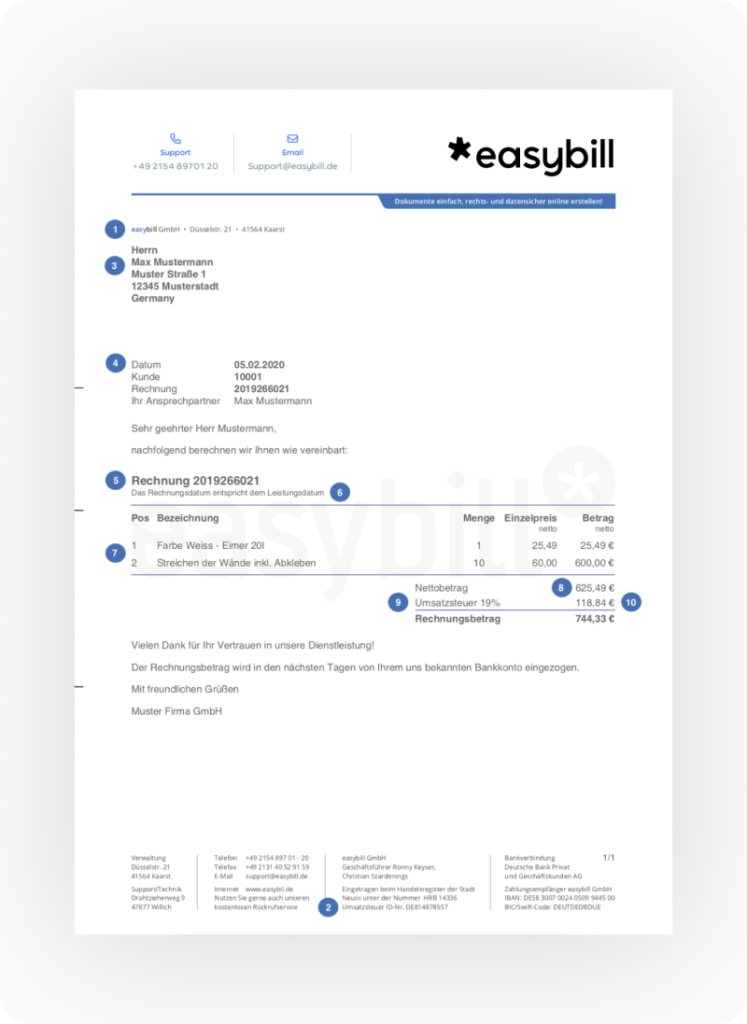
The same mandatory information applies to an e-invoice as to paper invoices in accordance with Section 14 of the German VAT Act (UStG), paragraph 4:
- Full name and address of you and your customer
- Tax number or VAT ID
- Date of issue (invoice date)
- Sequential invoice number
- Date of delivery or service
- Quantity and type of service or delivery
- Remuneration (net amount)
- VAT rate and VAT amount
- Gross amount
Are e-invoices secure?
E-invoices are not only efficient, but also secure:
- Encryption protects against unauthorized access.
- Strong authentication secures the systems against attacks.
- Regular updates ensure protection against new threats.
- For the tax office: E-invoices must be legible, authentic, and their content must be intact. From 2025, the previous consent requirement of the invoice recipient will no longer apply.
E-book on e-invoices to download
In the e-book from the invoicing software easybill, you’ll find all the important information, implementation tips, and answers to the most frequently asked questions about e-invoices:
- The future of accounting:
Find out what an e-invoice is exactly, what benefits it brings (such as fewer errors and greater transparency), and how it differs from traditional PDF or paper invoices. - Important deadlines and legal framework:
We’ll show you the phased introduction of e-invoicing, the applicable deadlines, and how the Growth Opportunities Act has extended the e-invoicing obligation to the B2B sector. - Formats in focus:
Do you already know the difference between XRechnung, ZUGFeRD, and EDIFACT? We’ll explain the formats and standards so you can choose the right one for your business. - Practical implementation tips:
You’ll receive step-by-step instructions for introducing e-invoicing, including a practical checklist to review your software. - Exclusive: Expert interview:
Learn how tax advisor Thomas Matisheck views e-invoicing as a “great opportunity and not a risk” and what consequences may arise in the event of non-compliance.
Additional legal and technical notes on e-invoicing
Reverse charge cases (§ 13b UStG)
The application of the reverse charge procedure does not change the e-invoicing obligation. What matters is whether a domestic B2B supply is involved for which an invoice must be issued in accordance with § 14 UStG.
Even if the recipient of the supply owes the VAT (§ 13b UStG), the invoice must be created in the structured e-invoicing format, provided that no statutory exemption applies.
Minimum technical requirements for receipt
There are no special system requirements for receiving e-invoices.
Transmission can still take place by email.
Mandatory access to the PEPPOL network does not exist in the national B2B area.
A central government platform for B2B e-invoices does not currently exist in Germany.
However, companies must ensure organizationally that e-invoices can be identified, checked, and processed in an audit-proof manner.
Archiving and GoBD requirements
E-invoices are subject to tax retention obligations and must be stored in the original format (e.g., XML file). Archiving must be done in an unalterable manner, must remain machine-readable, and must be traceable and verifiable at all times.
In addition, process documentation is required. This describes how e-invoices are received, processed, checked, and archived within the company.
A purely visual representation, such as a PDF view, is not sufficient.
Intra-Community and cross-border supplies
The German e-invoicing obligation applies exclusively to domestic B2B transactions.
In particular, intra-Community supplies, intra-Community services, supplies with a place of supply abroad, as well as third-country transactions are not covered.
For these scenarios, the general VAT invoicing requirements continue to apply, but there is no mandatory issuance in the structured German e-invoicing format.
Frequently asked questions about e-invoicing
They need software or a simple viewer to be able to read the e-invoice. They must also be able to review it and archive it correctly.
Commonly, the wrong formats are sent, the XML data set is missing or invalid, or the email contains too little contextual information.
It saves time, reduces errors, is processed faster, and lowers costs for paper, postage, and scanning.
Many consider PDFs to be e-invoices or use outdated formats. Some do not check the file before sending or archive only copies instead of the original file.
It is available as a structured file (e.g., XML or a PDF with embedded XML) and can be processed in a machine-readable way.
No. A simple e-invoice viewer is sufficient if no accounting software is available.
Yes. The sending method remains the same – the only important thing is the correct format.
No. A signature is not required.
Yes, they can be added as usual.
Yes, if you want to. It is not mandatory.
The recipient can reject it. A corrected version then has to be resent.
No. The obligation applies only to new invoices.
Yes, if the invoice amount is over 250 euros.
At least eight years – in the original format.
Here, the XRechnung is mandatory. You also need a Leitweg-ID and must submit the invoice via the designated portals.
Yes, if your software supports it.
No. You can continue using your existing number ranges.